
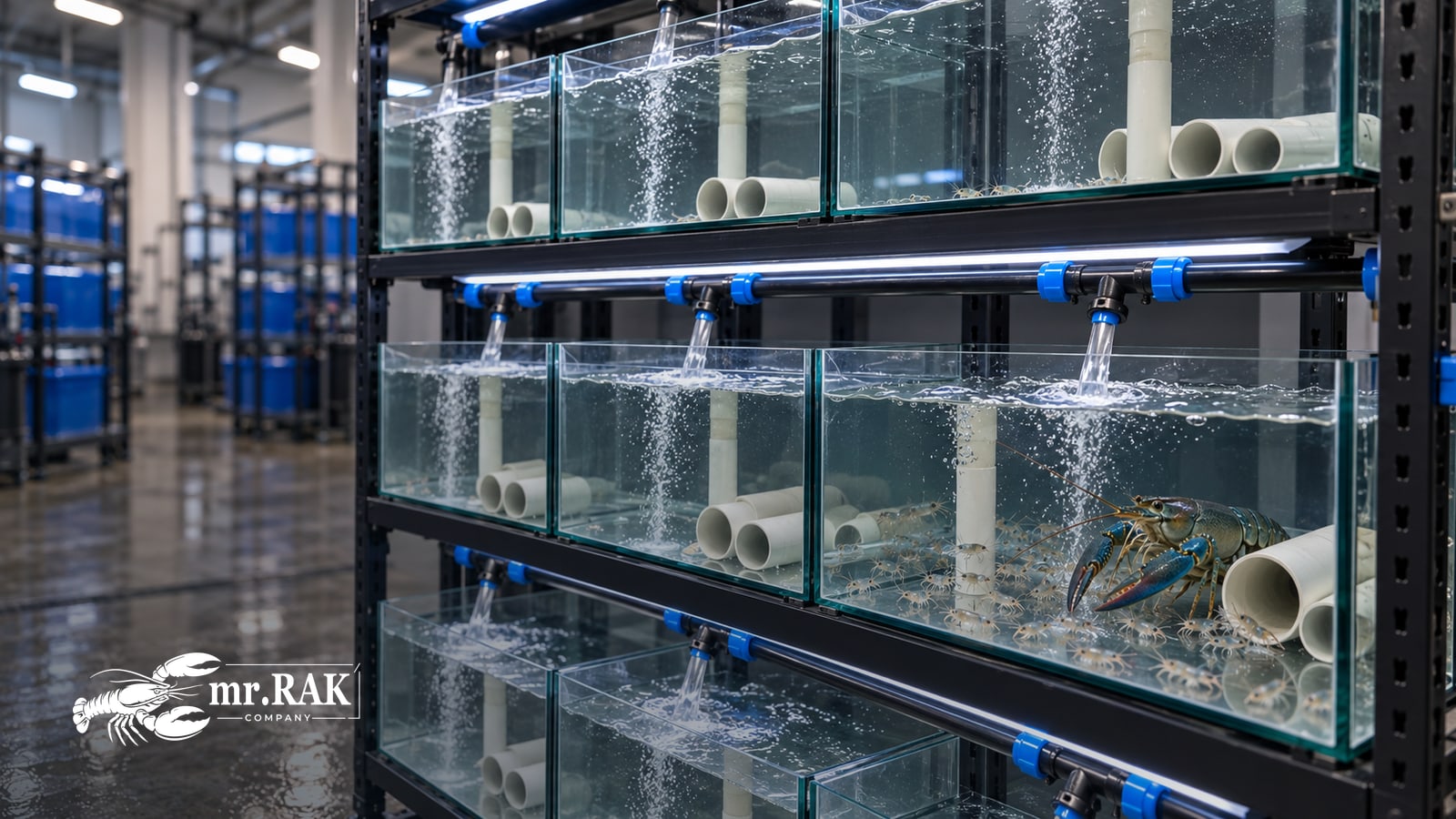
The Australian redclaw crayfish (Cherax quadricarinatus) is farmed from juveniles. You can buy juveniles ready-made, or you can produce them yourself — and that is what incubation is for. Here is a plain explanation of how it works in the MrRak incubator, what the package includes and how many juveniles you can expect.
In short:
incubation means getting juveniles in an incubator, where Australian redclaw females produce juveniles;
one female gives 300 to 1,000 juveniles, depending on care and the female’s age, 4 times a year;
a family of 9 females gives 10,800–36,000 juveniles a year;
the package starts from €3,240, and the payback period is up to 14 months.
What crayfish incubation is and why a farm needs it
First, the species itself. The Australian redclaw crayfish naturally has a blue-green shell, and males have a red patch on the claw. It is not dye and not a disease — it is simply the breed. The crayfish reach market weight in about 6 months.
Incubation means getting juveniles in a dedicated unit. The unit is called a crayfish incubator: in it, Australian redclaw females produce juveniles. Juveniles are young crayfish that are stocked into a system and grown to market size.
A farm has two ways to get them. The first is to buy juveniles ready-made. The second is to produce your own, and that is exactly what incubation is for. Below we explain what to do with them.
How a crayfish incubator works
The MrRak incubator is not a single piece of equipment but a complete package for starting your own juvenile production. You get the module, the breeding stock, the training and the support. Everything in one pair of hands: you never have to assemble a farm from parts supplied by different vendors and then work out who is responsible for the result.
What the package includes:
an incubation module sized to your premises — we take the measurements and build the system to fit the space you already have;
a crayfish family: 9 females and 3 males ready to breed, from our own certified hatchery;
a water treatment and biofiltration system;
training: 2 days on the farm plus online;
24/7 consultation support after launch.
All of this is already included in the price of the package: you do not need to buy anything from this list separately.
The females are the main players in this system: they are the ones that produce the juveniles. The module, water treatment, training and support are there so that you can launch the process and keep it going.
How it works, step by step
You pay for the incubator.
We assemble the module.
We explain everything and guide you from there.
You arrange the delivery.
On site you set the module up yourself — or we do it.
The females become berried and release juveniles.
The key moment is the last step: that is where incubation happens. Everything about installation is up to you: you arrange the delivery, and you can set the module up yourself or ask us to do it.
How many juveniles a female gives, and the whole incubator
This is the question people ask most often when they think about an incubator. We answer with the numbers we rely on when we size the package.
One female gives 300 to 1,000 juveniles, depending on care and the female’s age, and does so 4 times a year. The package includes a family of 9 females. Put together:
9 females in the family;
300–1,000 juveniles from each;
4 times a year.
In total, 9 × 300–1,000 × 4 — 10,800–36,000 juveniles a year. This is a calculated figure.
How to read this number. 10,800–36,000 is the total for the whole package over a year. One female gives 300 to 1,000 juveniles, but does so 4 times a year, and the family has 9 females — which is where the total comes from. Where exactly your result falls in this range depends on care and the age of the females.
The calculation counts the females: you get the family at once, 9 females and 3 males ready to breed. You do not have to look for or buy extra breeding stock to get started.
What to do with the juveniles
Once the juveniles are there, you grow them on. The crayfish reach market weight in about 6 months, so a batch of juveniles is the start of a half-year cycle.
Need more juveniles, or larger ones? We also sell them separately: standard juveniles are 1–2 cm, grown-on juveniles are 4–5 cm, the minimum order is 100 pieces, and juveniles are available all year round. Send us a request to get the price. The details are on the page “Redclaw Crayfish Juveniles”.
Who the incubator is for, and who should buy ready-made juveniles
The incubator suits people who want to produce juveniles of their own rather than buy them. If you want to try first, there are training and test kits — see the Prices page.
If you need juveniles for grow-out rather than for breeding, buying them ready-made is simpler. They are available all year round, so there is no season to wait for. You can get them by Nova Poshta, in our own vehicle, or collect them from the farm. With the juveniles you get advice on keeping them, a care instruction, and replacement of juveniles that die in transit.
How much it costs to start an incubator
The package starts from €3,240. The word “from” is deliberate: the size of the module is chosen to fit your premises, so the price starts from this amount.
The price already includes the module, the crayfish family, water treatment and biofiltration, training (2 days on the farm plus online) and 24/7 support after launch. One step you arrange yourself is the delivery.
The payback period is up to 14 months. To pick the package for your premises, leave a request on the site — the “Leave a request” button. Prices of other equipment are collected on the Prices page.
What to decide before you order an incubator
Before ordering the package, it is worth answering a few simple questions.
What your premises are like. The module is built to fit them, so the size of the premises is the first thing to know. Leave a request and a technologist will help you with this.
How you will bring the module in. You arrange the delivery, so think this through in advance.
Who will set the module up on site. You can do it yourself, or ask us to do it.
How you will plan the cycle. The crayfish reach market weight in about 6 months, so a batch of juveniles is the start of a half-year cycle.
Whether you need training. It is already in the package: 2 days on the farm plus online, and 24/7 support after launch.
If you do not have the answers yet, that is fine: we explain everything and guide you from there.
How to get started
The order of steps is simple. First, leave a request — a technologist will pick the incubator for your premises. Then order the package — the “Order the incubator” button on the package page. After that everything follows the steps described above — from payment to the moment the females release the juveniles.
Whom to trust with such a purchase is a fair question. MrRak has 9 years of experience, 285 farms, 320 trained clients and a team of 21 specialists. The technologist Roman Bezverkhyi developed the combined culture technology we work with.
You will find all the details of the package, its price and the order button on the page “Redclaw crayfish incubator”. That is where you can order the incubator — in this article we only explain how it all works.
Questions and answers about crayfish incubation
How many juveniles does a redclaw female give?
300 to 1,000 juveniles, depending on care and the female’s age, and she does so 4 times a year.
How many juveniles does an incubator give per year?
10,800–36,000: 9 females × 300–1,000 juveniles × 4 times a year.
How does a crayfish incubator work?
You get a module sized to your premises and a crayfish family — 9 females and 3 males ready to breed. The females become berried and release juveniles. We assemble the module, explain how everything works and guide you from there after launch.
How much does an incubator cost, and is training included?
The package starts from €3,240, and the payback period is up to 14 months. Training is included in the price: 2 days on the farm plus online, and 24/7 support after launch.
I need ready juveniles, not an incubator. What should I do?
We sell juveniles separately: standard juveniles are 1–2 cm, grown-on juveniles are 4–5 cm, the minimum order is 100 pieces, and juveniles are available all year round. Details are on the page “Redclaw Crayfish Juveniles”.